1. Option 1: Liquid Culture
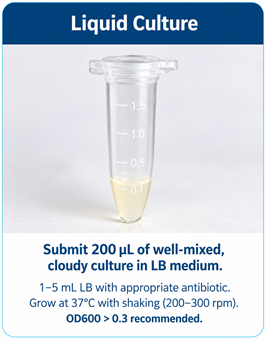 |
Liquid cultures are a convenient submission option for Direct Colony Sequencing when your E. coli clone is already growing in culture.
- Inoculate a single colony into 1–5 mL of LB medium containing the appropriate selection antibiotic.
- Grow the culture at 37°C with shaking at approximately 200–300 rpm.
- Allow the culture to reach sufficient cell density before submission. The culture should be visibly turbid.
- Transfer 200 µL of well-mixed, cloudy culture in LB medium into the specified sample tube for submission.
Cultures with very low cell density may provide insufficient bacterial material for DNA preparation and can increase the likelihood of an unsuccessful sequencing result.
Important: This workflow is intended for E. coli. Other bacterial species are not supported unless otherwise specified.
Submitted sample material is not returned. Retain the remaining culture for storage, additional growth, or downstream experiments.
|
| |
|
2. Option 2: Cell Pellet
|
|
Grow your E. coli culture under the appropriate conditions for your strain and construct.
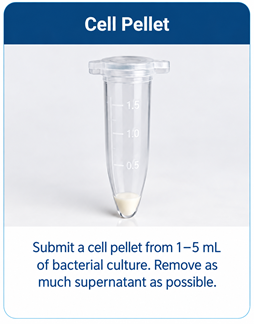
Transfer 1–5 mL of bacterial culture to a suitable centrifuge tube and centrifuge until a compact cell pellet forms. Carefully remove the supernatant without disturbing the pellet, removing as much residual liquid as possible.
Do not resuspend the pellet. Securely close and label the tube, then submit the cell pellet for Direct Colony Sequencing – Sanger. Eurofins will perform the appropriate DNA preparation based on the prep option selected for your sequencing target.
What to submit:
A compact cell pellet prepared from 1–5 mL of bacterial culture, with the supernatant completely removed.
Important: This workflow is intended for E. coli. Other bacterial species are not supported unless otherwise specified.
|
3. Option 3: Colony
Select this option if you have not grown up your colony and need us to grow it OR if you are submitting a resuspended colony.
 |
Colony
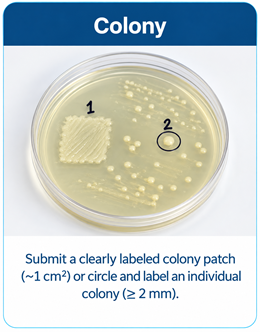
Submit your E. coli colonies directly on an agar plate as individual colonies or clearly labeled colony patches.
For colony patches:
Create approximately 1 cm² patches, with each patch originating from a single colony. Clearly number each patch so that it matches the corresponding sample number in your Sanger sequencing order.
Incubate the plate until sufficient visible bacterial growth has developed before submission.
For individual colonies:
Clearly circle and number each colony you would like sequenced. Each colony should be:
- At least 2 mm in diameter
- Well isolated from neighboring colonies
- Clearly marked and numbered to match the corresponding sample in your sequencing order
For low-copy plasmids, larger colonies are preferred to provide sufficient starting material.
Before shipping:
Secure the plate lid with Parafilm and place the sealed plate inside a protective resealable bag. Use only enough Parafilm to securely seal the plate, as excessive wrapping can make the plate difficult to open.
Important: This workflow is intended for E. coli. Other bacterial species are not supported.
|
| |
|
 |
Colony - Resuspended
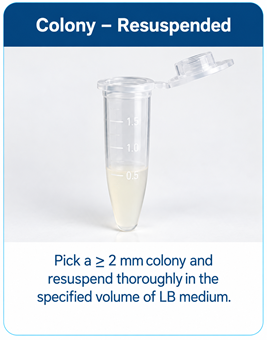
Colony resuspension provides a convenient way to submit E. coli colonies for Direct Colony Sequencing without preparing an overnight culture or performing DNA extraction yourself.
- Select a well-isolated colony at least 2 mm in diameter.
- Transfer as much of the colony as possible into the specified volume of LB medium in an approved PCR strip tube or compatible plate.
- Mix thoroughly until the cells are evenly suspended.
- The suspension should appear visibly cloudy, indicating sufficient bacterial material.
- Securely close or seal the tube or plate and clearly label the sample to match your Sanger sequencing order.
- Submit the prepared colony suspension according to the Direct Colony Sequencing submission requirements.
For low-copy plasmids, use a larger colony when possible to provide sufficient starting material.
Important: This workflow is intended for E. coli. Other bacterial species are not supported.
|